

I arrived back in Korea yesterday after spending three and a half weeks in the Netherlands with family and friends. It was wonderful to be back in that flat landscape again, and I especially enjoyed the dunes, the beaches and the wonderful landscape on Ameland – island. But as nice as it is to be away, coming home always feels good. And what struck me right away: flags everywhere along the streets and highways. No, not to welcome me back (ahum), but……bvecause of Celebrating the ‘birth of Korea’.
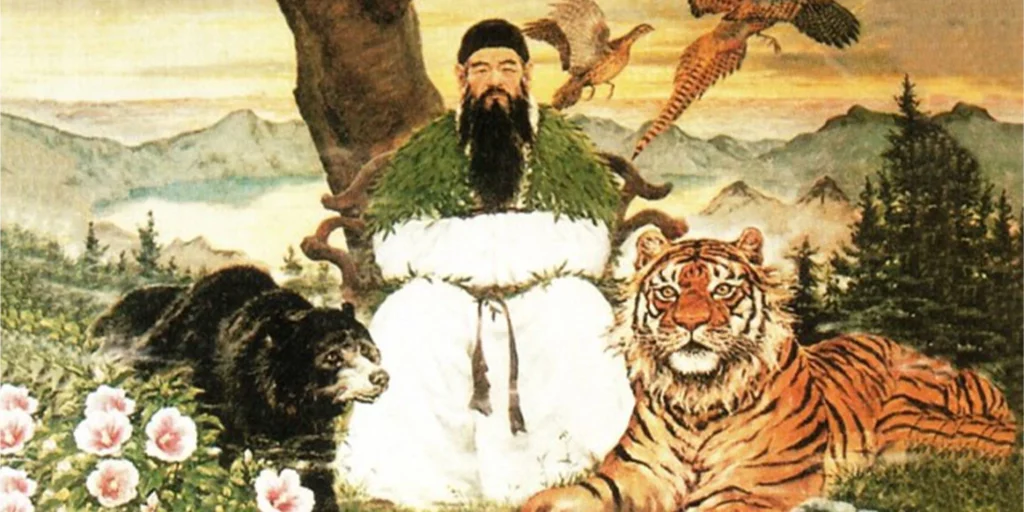
October 3: Celebrating the ‘birth of Korea’.
Tomorrow is October 3, still an official national holiday in Korea: 개천절 (Gaecheonjeol) – the day the “heavens opened” and, according to legend, Korea was born.
The Story Behind the Day
The story goes like this: the heavenly god Hwanin had a son, Hwanung, who longed to live among humans. He was granted permission by his father and descended to earth with 3,000 helpers. On a mountain, usually identified as Taebaeksan (sometimes linked to Mount Paektu on the border between China and North Korea), he built a heavenly city. There he brought order and knowledge: laws, agriculture, medicine, and more than three hundred kinds of skills needed to build a society.
Then comes the part nearly every Korean knows. A bear and a tiger came to Hwanung with the wish to become human. Hwanung set them a test: they had to remain in a dark cave for one hundred days, avoiding sunlight, and live only on garlic and mugwort (a medicinal herb). The tiger soon gave up. The bear persisted, and after 21 days she was transformed into a woman: Ungnyeo.
Ungnyeo was grateful, but also lonely, as she had no partner or child. She prayed under the sacred tree on the mountain. Hwanung saw her wish, married her, and together they had a son: Dangun Wanggeom.
According to tradition, Dangun grew up and in 2333 BC founded the first Korean kingdom: Gojoseon. He is therefore regarded as the mythical founder of Korea.
Why This Story Matters
At first glance, it reads like a fairy tale – and it is one. But the symbolism is richer than it looks. The bear and the tiger were not just random animals. In many ancient cultures of Northeast Asia, clans or tribes often identified themselves with totem animals that carried certain qualities. The bear, for example, was linked with endurance, fertility, and protection. The tiger, on the other hand, symbolized strength, ferocity, and danger. In the story, the tiger cannot finish the trial, while the bear has the patience to persevere. That choice – the bear becoming the ancestress – may well reflect an older memory that a “bear clan” or a group that associated itself with the bear eventually grew more important and left the strongest mark on the early identity of the Korean people.
The test with garlic and mugwort may sound strange to us now, but it also has roots in tradition. Both were used as medicinal plants, believed to cleanse the body and drive away evil spirits. So the story can also be read as a kind of purification ritual. Before one could become “human” in a full sense, one first had to go through hardship, discipline, and cleansing. In that sense, the myth contains a message that goes beyond magic: it tells us that perseverance and discipline, even more than raw strength, are what lead to transformation and progress.
The descent of Hwanung from the heavens is another element that carries weight. The idea that rulers or founders had divine origins was common across the region. In China, emperors claimed the “Mandate of Heaven” to justify their rule. In Japan, the imperial family traced its lineage back to the sun goddess Amaterasu. Korea’s version – a son of the heavenly god coming down to bring order – fits into this wider cultural pattern. It is a way of saying: our nation does not just begin with chance or conquest, but with a higher order, with a story that places Korea on equal footing with its neighbors.
So why is this still relevant today? Because for Koreans, it is more than just a story told to children. It represents a sense of unity and continuity that is vital for a country with such a turbulent history. During the Japanese colonial period (1910–1945), when Korea was stripped of its sovereignty, the Dangun myth was retold and emphasized as proof that the Korean nation was ancient, independent, and had its own roots long before Japan’s rise. Later, in the 20th century, after Korea was divided into North and South, the story still carried weight. It gave people a reminder that, despite political borders, both sides of the peninsula looked back to the same ancestor. In a way, Dangun became a symbol of shared heritage that crossed ideological lines.
October 3, then, is not simply about a legendary figure from thousands of years ago. It is about national pride, resilience, and identity. For modern Koreans, it is a day to look back at where they come from, but also to reflect on what still binds them together. The flags on the streets, the ceremonies at sites like the Chamseongdan altar, and the quiet recognition of the day by ordinary people all carry that message: that Korea, however divided or challenged in history, sees itself as one nation with deep and unique roots.
This is why Gaecheonjeol is still celebrated today. It is less about whether the story literally happened and more about what it stands for. A reminder that myths, even when they look like fairy tales, can carry powerful lessons – about endurance, about the need for unity, and about the pride of a people in their own history. October 3 is, in that sense, both a celebration of an ancient legend and a reaffirmation of national independence and identity.Cultural Importance for Today
Days like October 3 are more than just a reminder of the past. In Korea, national holidays and cultural events play an important role in everyday life and in business. For foreign entrepreneurs and companies working here, it is useful to know these dates. Not only because offices and shops may be closed, but also because these days are moments when national identity, family, and tradition come strongly to the surface. Understanding them helps you connect better with partners, clients, and employees.
Koreans expect that outsiders who want to do business here show some awareness of the cultural calendar. Knowing why flags are everywhere on October 3, or what the upcoming celebration of Chuseok means for family life, makes a real difference in how you are perceived. It shows respect and helps build trust.
Key National Holidays in Korea
- Seollal (설날) – Lunar New Year, usually in January or February, one of the biggest family holidays.
- Independence Movement Day (삼일절, Samiljeol) – March 1, commemorating the 1919 movement against Japanese rule.
- Children’s Day (어린이날) – May 5, a joyful day dedicated to children.
- Memorial Day (현충일) – June 6, honoring fallen soldiers.
- Liberation Day (광복절) – August 15, marking the end of Japanese colonial rule in 1945.
- Chuseok (추석) – Mid-Autumn Festival, September/October, another major family holiday.
- National Foundation Day (개천절, Gaecheonjeol) – October 3, celebrating the mythical founding of Korea.
- Hangul Day (한글날) – October 9, celebrating the creation of the Korean alphabet.
- Christmas (성탄절) – December 25, recognized as a public holiday.
Sources
- Samguk Yusa (삼국유사), 13th century, which records the Dangun myth.
- National Folk Museum of Korea – explanations about national holidays.
- Cultural Heritage Administration (information about the Chamseongdan altar).
- World History Encyclopedia & Wikimedia Commons (portraits and images of Dangun).

One comment
Hi Riemer,
Its great to see how fast and well you have “landed” in Korea!
Very nice to see you blogging away and sharing some rare insights.
Keep at it!
Andreas