
Doing Business in Korea Starts with Being Here
What a day at Asia Offshore Wind Day in Busan tells us about networks, market access and doing business in Korea
When we say that KramerConsult works across borders, there is an important part of that statement that can easily be overlooked: we are actually here, in Korea.
We are based in Busan. We meet companies, chambers, government representatives and other organisations. We attend events where developments in the Korean market are discussed and where people from different industries and countries meet.
Over time, those encounters create relationships and a better understanding of who is active where.
That matters when an overseas company or organisation starts exploring Korea.
Our Dutch roots naturally give us a strong connection with the Netherlands and Dutch-Korean business. But the network we build in Korea is much broader. Companies from elsewhere in Europe and beyond often face similar questions when trying to understand the Korean market, identify potential partners or establish their first local connections.
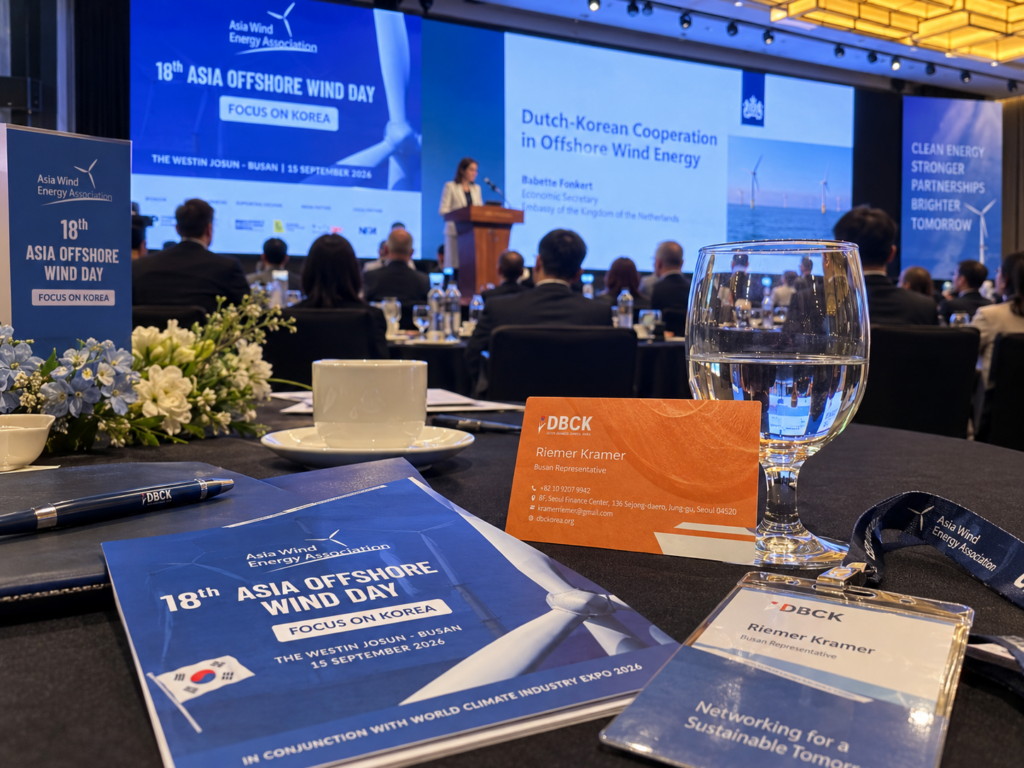
The 18th Asia Offshore Wind Day – Focus on Korea, held in Busan on 15 September, provided a good example of how this works in practice.
I attended the conference in my additional role as Busan Representative of the Dutch Business Council Korea (DBCK).
Offshore wind is not a specialist field of KramerConsult, and I would not present myself as an expert in it. That was not the reason for being there.
The value was in being present in a room where an important Korean industry is developing.
An ambitious Korean market
Korea has substantial ambitions for offshore wind. The government’s ten-year roadmap foresees 55 GW of offshore-wind tenders between 2026 and 2035, with at least 4 GW to be tendered annually. The target for cumulative installed offshore-wind capacity is 25 GW by 2035.
The regulatory environment is changing as well. Korea’s Offshore Wind Act came into effect in March 2026 and introduces a more government-led approach to identifying and developing suitable areas. The government intends to designate 25 GW of preliminary development zones by 2031.
The discussions in Busan showed what lies behind those figures. Projects depend on matters such as grid connections, permitting, financing, suitable infrastructure and local stakeholder involvement. Experiences from Taiwan, Japan and Europe provide useful reference points, while Korea has its own industrial and regulatory environment.
For an international company, following these developments from inside Korea provides a different perspective from reading about them from abroad.
A Dutch connection — and international opportunities
There was naturally a particular Dutch dimension to the conference.
Babette Fonkert, Economic Secretary at the Embassy of the Kingdom of the Netherlands in Korea, spoke about Dutch-Korean Cooperation in Offshore Wind Energy.
The Netherlands has accumulated extensive experience through offshore-wind development in the North Sea and has built a specialised maritime and offshore industry around it. Korea has considerable capabilities of its own, particularly in shipbuilding, engineering and the wider maritime economy.
That creates potential for cooperation.
But identifying complementary strengths between countries is only a starting point. For a company considering Korea, the questions quickly become practical.
Who is active in this market? Which organisations or companies could be relevant? How does the sector work in Korea? And who should we approach first?
These questions are certainly not unique to offshore wind.
They are questions we regularly encounter when organisations start exploring Korea.
A market is also made up of people
A great deal can be learned about Korea through market studies, government publications, databases and online research.
But a market is also made up of people.
A conversation at an industry event may provide a perspective that does not appear in a market report. Someone encountered in one context may later know the person needed for a completely different question. A previous introduction can make a new conversation considerably easier to start.
Networks develop gradually. Their value often becomes visible only later, when somebody asks:
“Do you know who we should talk to in Korea?”
This is why our activities in Korea extend beyond KramerConsult’s own client work.
My role as Busan Representative of DBCK connects us closely with Dutch and Korean business interests. Our membership of the European Chamber of Commerce in Korea (ECCK) places us within a much wider European and international business community. We also maintain contacts with the Embassy of the Kingdom of the Netherlands, Korean organisations, universities and companies from different countries.
Asia Offshore Wind Day offered another opportunity to strengthen those relationships, including our cooperation with ECCK and contacts with Korean and international businesses and organisations.
Not every conversation needs to produce immediate business. Often it does not.
The value lies in gradually knowing more people, understanding what they do and being able to reconnect when there is a reason.
Dutch roots, but not Dutch-only
Our Dutch roots remain an important part of KramerConsult.
They give us a natural affinity with Dutch-Korean business and access to networks that can be particularly useful to organisations from the Netherlands.
They do not define the limits of our work.
A company entering Korea often faces similar practical questions whether it comes from the Netherlands, another European country or further afield.
KramerConsult can help at that early stage: understanding the Korean context, exploring a market, identifying potential counterparts and establishing the first relevant connections.
That does not mean claiming specialist expertise in every industry.
If an offshore-wind company approached us tomorrow, we would not suddenly become offshore-wind engineers. We would first want to understand what that company is looking for in Korea. From there, we can determine what we can do ourselves and where our network or external specialist expertise becomes more useful.
Sometimes our contribution may involve research and market orientation. In another case, one good introduction may be the most valuable thing we can provide.
Knowing the difference matters.
Why being in Busan matters
Our location in Busan is another important part of how we work.
Seoul is Korea’s political and corporate centre and is essential to the national business environment. At the same time, a large part of Korea’s industrial economy lies elsewhere.
Busan and the southeast have deep connections with ports, shipbuilding, logistics, marine engineering and manufacturing. For a subject such as offshore wind, that makes Busan a particularly relevant place to be.
For KramerConsult, it also means building a network in an important Korean economic region while remaining connected to national and international networks elsewhere in the country.
The Asia Offshore Wind Day was another step in developing that presence.
DBCK became a Supporting Organization of the conference at very short notice. Edgare Kerkwijk and the Asia Wind Energy Association nevertheless ensured excellent visibility for DBCK throughout the event, alongside ECCK, DCCK and other international organisations.
By the end of the day, I knew considerably more about offshore wind than when I entered the room. I had also made new contacts and strengthened existing relationships.
For KramerConsult, that second part is particularly relevant.
Being there changes the conversation
An international company can research Korea from almost anywhere.
At some point, however, research has to become contact. Someone needs to speak with a potential partner, test an assumption, understand how an organisation really works or find out who is actually responsible for a particular subject.
That is when having someone on the ground starts to make a difference.
KramerConsult has Dutch roots, a permanent presence in Korea and a growing Korean and international network.
We will not pretend to know every industry or already know every person a client may need.
But we are here. We know where to start looking, and increasingly, we know whom to ask.
Sometimes that is where doing business in Korea begins.