

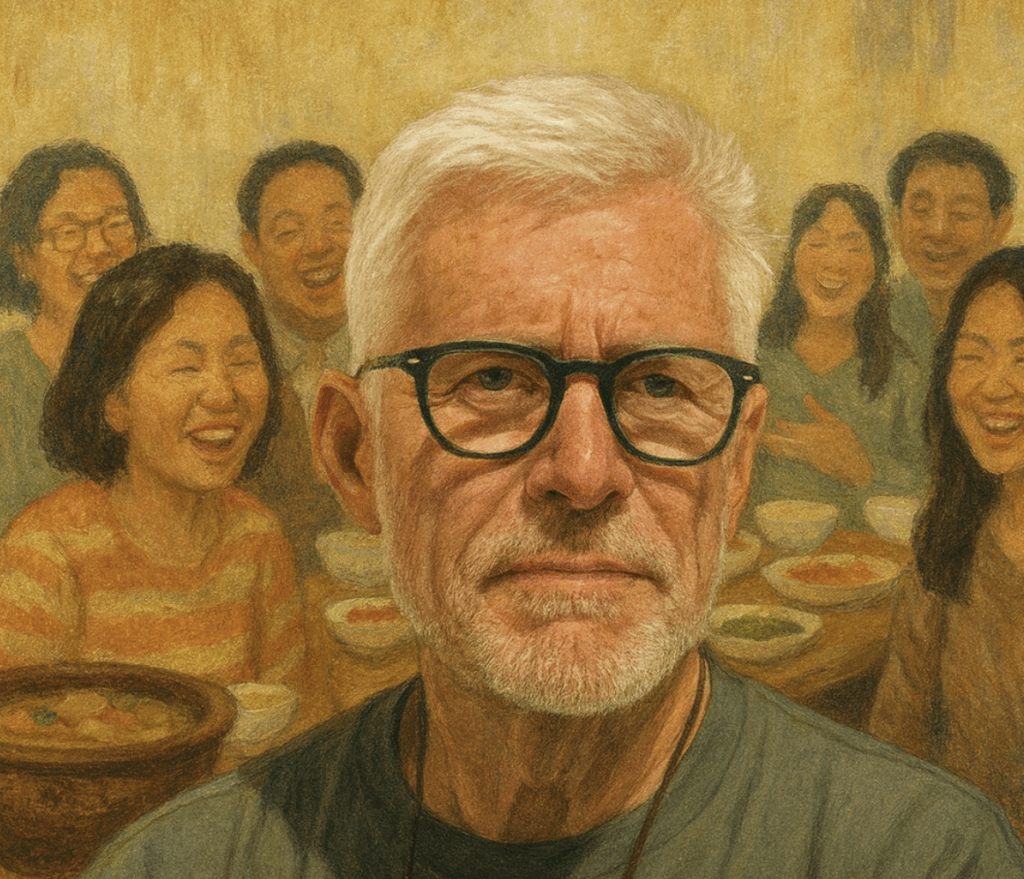
There are days when you suddenly feel like a complete foreigner again.
Today was one of those days.
Two family gatherings in one day.
Twice a room full of people who have known each other their whole lives.
Twice a table overflowing with food, laughter, warmth — and a language of which I understand maybe ten percent at best. And at that moment I need to get The Art of Smiling from my social skills toolbox.
It always begins hopefully. A few polite greetings, a respectful bow, a couple of short Korean sentences I’ve practiced. Everyone smiles back, kind and welcoming. For a brief moment, I feel confident. And then… the fireworks begin.
Within minutes, the room fills with rapid-fire conversation. Words overlap, jokes bounce back and forth, someone shouts from the kitchen, and laughter erupts in waves. It’s like being caught in a cheerful storm — beautiful to witness, impossible to follow.
I sit there with a glass in my hand and a smile that slowly turns mechanical. Every now and then I catch a familiar word — saram (person), chingu (friend), bap (rice) — but it’s like watching a movie without subtitles. The laughter rolls around the table, and I laugh along, usually half a second too late and probably for the wrong reason. Somewhere inside all that warmth hides a quiet kind of loneliness that only those who’ve lived abroad might fully understand.
It’s not that anyone is unfriendly — quite the opposite. Korean families are generous, warm, and sincerely caring. Dishes are passed around endlessly, your glass is refilled before it’s even half empty, and everyone insists you eat more. The hospitality is genuine. But communication? That’s another story.
Few of the older relatives speak English, and even the younger ones often hesitate. Not out of unwillingness, but out of modesty — afraid to make mistakes or embarrassed to switch languages in front of others. And really, who can blame them? It’s their home, their comfort zone. I’m the visitor. Still, it means that conversations become something I witness, not something I join.
And then there’s the Busan dialect — satoori (사투리). Charming, melodic, and for learners like me, a whole new mountain to climb.
In standard Korean, someone might say “eodi gaya?” (“Where are you going?”), but in Busan it becomes “eodi ganda?” — shorter, rougher, with a falling tone that sounds almost like a statement instead of a question.
Or “mwohae?” (“What are you doing?”) turns into “mohanda?” — again that same confident, matter-of-fact rhythm.
Even simple greetings sound different — “annyeong” becomes “annyang” — warmer somehow, but to my ear still unpredictable.
The biggest challenge isn’t vocabulary; it’s tone.
In Seoul, questions rise at the end. In Busan, they often drop — which makes it sound like everyone is slightly annoyed, even when they’re not. After months here, I’ve learned: Busan people sound tough, but their hearts are soft.
By the time the second gathering begins, my mind feels full — not from the food or the drinks, but from the effort of constant listening. My face hurts from smiling. The same polite greetings repeat: “Annyeonghaseyo! Jal jinaeseyo?” (Hello, have you been well?).
And still, beneath the fatigue, there’s pride. Because I’m there.
Among family, among stories I can’t yet understand, between two cultures that slowly begin to overlap.
People often imagine that living abroad is a string of cheerful moments — new food, new friends, new adventures. And yes, that’s true. But not everything is “hurray.”
There are quiet days like this, when the simplest thing — joining a family dinner — becomes a lesson in patience and humility. You learn that belonging takes time, and that sometimes connection starts not with words, but with presence.
When I finally step outside — night air, city lights, a bit of silence — I think: this too is part of starting a new life.
You sit there, sometimes lost, sometimes invisible, but still there.
Language will come later.
Smiling still helps for now.
Happy Chuseok! 🙂