

The Little Dutch Boy Has a Bigger Water Problem Now
Climate change is forcing the Netherlands to rethink some old assumptions. From Busan, I wondered how different the Korean problem really is — and where the two countries may work together.
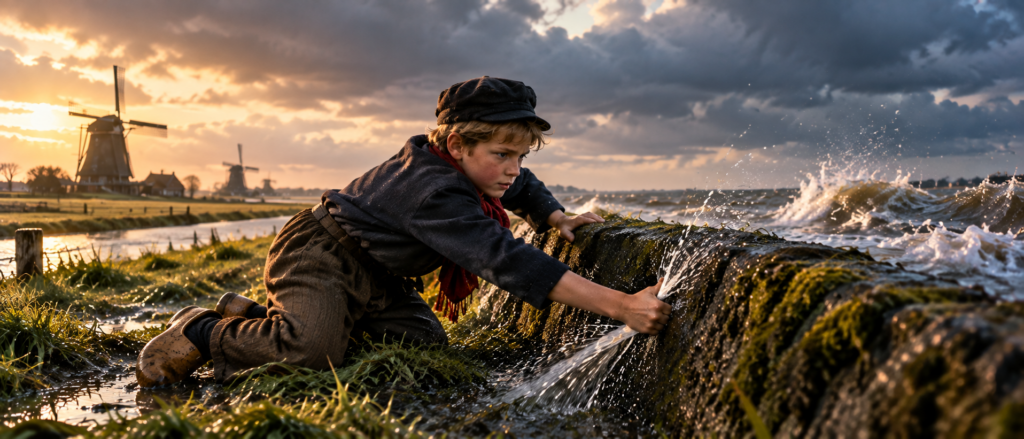
The little Dutch boy with his finger in the dike has apparently made it all the way to Korea.
I was surprised to find the story in Korean media and even in Korean government-related publications about the Netherlands and water management. The image is familiar here too: a boy discovers a hole in a dike, pushes his finger into it and prevents a flood.
There is a small problem with this famous Dutch story. It never happened.
It came from Hans Brinker, or The Silver Skates, published in 1865 by the American writer Mary Mapes Dodge. The boy in the dike episode was not actually Hans Brinker either. Dutch folklore researchers have pointed out that the story was unknown in the Netherlands before Dodge’s book appeared.
Still, the story has travelled remarkably well. It also gives a wonderfully simple picture of Dutch water management: find the leak and fix it.
I thought of that boy again this week while watching Dutch Delta Commissioner Co Verdaas explain why dealing with water in the Netherlands is becoming considerably more complicated.
A very Dutch warning
The timing was interesting. The Netherlands has just had its warmest summer since national measurements began in 1901. The average temperature was 19.3°C, compared with the current normal of 17.5°C. The summer was dry as well. At the end of August, the national precipitation deficit stood at around 285 millimetres, putting 2026 among the driest 5% of years measured.
KNMI also reported in July that the continuing European drought had been made worse by climate change. The main mechanism was straightforward: higher temperatures increase evaporation and dry the soil more quickly. The research did not claim that climate change created every period without rain. It found that warming had made the resulting drought substantially more severe.
That was the background to Verdaas’ message when the latest review of the Dutch Delta Programme was presented on 7 September.
The review concludes that the present approach will not be sufficient for the climate conditions the Netherlands is moving towards. Dikes, barriers and pumps remain part of Dutch water management. More attention will now have to go to keeping freshwater available during dry periods and giving water space where that is necessary. In some coastal areas, increasing salinity may eventually require different use of the land.
For somebody who grew up in the Netherlands, that is quite a statement.
We are used to the idea that water is something the Dutch know how to control. Verdaas is saying that future policy will also have to adapt to the water that is actually available. Decisions about housing or agriculture can therefore no longer be separated so easily from water management.
That is a much bigger job than putting a finger in a dike.
And then El Niño appeared in the news
At almost the same time, El Niño was making headlines.
On 3 September, the World Meteorological Organization said the current El Niño is expected to develop into a very strong event, with an almost 100% probability that it will persist through February 2027. WMO expects significant effects on rainfall and temperatures in parts of the world.
I initially wondered whether that explained some of the Dutch warnings.
It doesn’t, at least not directly.
El Niño is a natural fluctuation in the tropical Pacific. During an El Niño event, unusually warm water develops across the central and eastern equatorial Pacific and affects atmospheric circulation. Some regions then experience fairly recognisable changes in rainfall or temperature. The phenomenon existed long before modern climate change.
The Netherlands is not one of the places where the connection is particularly strong. KNMI finds only a limited El Niño signal in Dutch weather. One of the better documented effects is a greater chance of a wet spring after a strong El Niño.
The current Dutch discussion is therefore mainly about climate change, rather than El Niño.
El Niño can temporarily add extra warmth to the global climate and produce major regional weather effects elsewhere. It is taking place now in an atmosphere and ocean system that are already unusually warm. WMO itself stresses that local outcomes vary considerably and that other oceanic patterns can reinforce or weaken the usual El Niño effects.
That made me curious about Korea.
Does El Niño matter more in Korea?
Korea is much closer to the Pacific system where El Niño originates, and the Korea Meteorological Administration follows it closely.
On 24 August, KMA reported that the Niño 3.4 monitoring area was 2.7°C above normal and expected conditions to develop into a strong El Niño during September–November.
That still does not give us a simple Korean weather forecast.
KMA’s own analysis of the summer of 2026 illustrates the problem rather well. It attributes this summer’s weather to several atmospheric conditions, including blocking patterns and the behaviour of the North Pacific High. During the same summer, central Korea experienced periods of very heavy rain while parts of the south suffered heat and drought.
So I would be careful with headlines suggesting that El Niño itself is about to bring Korea one particular type of extreme weather.
It is one factor being watched by Korean meteorologists. Climate change is the longer issue.
Korea has had its own warning signs this summer
The Korean summer statistics are striking enough without attributing everything to El Niño.
The national average temperature for summer 2026 was 25.4°C, the third highest since Korea greatly expanded its nationwide observation network in 1973. Rainfall over the summer as a whole was below normal. In July, Gyeongnam recorded its lowest July rainfall in the national record used by KMA, and severe meteorological drought developed in areas including Busan, Gimhae and Ulsan. Later in August, Geoje received extraordinary rainfall over only a few days.
The sea around Korea was exceptionally warm too. KMA measured an average summer sea-surface temperature of 24.3°C around the peninsula, the highest for the past ten years of the monitoring series it reported. The South Sea averaged 25.4°C, also the highest in that ten-year period.
Those figures are observations. They do not, by themselves, tell us how much of any individual drought or rain event was caused by climate change.
The policy response tells us something else.
Busan already treats heat, flooding and sea-level rise as climate risks that need to be considered in planning. The city’s official climate-impact assessment specifically refers to reducing impermeable surfaces and installing rainwater-storage facilities when considering heavier urban rainfall. Busan also publishes a climate-change report covering local trends and adaptation measures.
That is enough reason to take the subject seriously without pretending that Busan and Rotterdam have the same problem.
They don’t.
The Netherlands has huge low-lying areas and major river systems. Freshwater availability and salt intrusion have become increasingly important alongside flood protection.
Korea is mountainous and receives much more intense summer rainfall. Dense cities such as Busan sit directly against the coast and between steep terrain. Typhoons also belong to the Korean risk picture.
The technical solutions will therefore be different.
This is where my own interest starts
I am not a climate scientist or a hydraulic engineer, and I do not intend to become one for the purpose of writing a blog post.
My interest is the relationship between the Netherlands and Korea.
I spend much of my work looking at where organisations and companies in the two countries might have a practical reason to find each other. Once I started reading about water and climate adaptation, I discovered that some of those connections already exist.
K-water and the Dutch research institute Deltares, for example, signed a cooperation agreement in 2015. Their plans included modelling for extreme floods, sharing water-management technology and developing joint integrated-water projects in Asia. The relationship between K-water and Deltares actually goes back further; K-water records a strategic technical cooperation agreement from 2010.
Deltares has also worked with the Korea Institute of Ocean Science and Technology on coastal erosion along Korea’s east coast. From 2015 to 2018, the project developed numerical modelling methods and included practical guidance and capacity building for Korean coastal engineers.
Those examples appeal to me because there is no need to invent a vague “climate partnership”. A Korean problem was being studied and Dutch expertise could contribute to the work already taking place here.
The cooperation also moves beyond traditional water management.
In June this year, the Korea Wind Energy Industry Association and Maritime & Offshore NL signed an agreement in Yeosu covering offshore wind and maritime industries. The stated objectives include technology exchange, cooperation between supply chains and identifying business opportunities for companies in both countries.
Busan and Rotterdam already have another connection. Busan Port Authority operates a logistics centre in Rotterdam. In April this year, BPA met the Dutch ambassador and NFIA representatives to discuss further cooperation, including greener port operations and logistics.
I would not try to predict from these examples which climate-related projects will appear next. The facts support a more modest conclusion: organisations in the two countries already know each other and there is a record of technical cooperation.
Climate change can make some of those existing relationships more relevant.
There is knowledge on both sides
The Dutch reputation for water management is deserved, although the latest Delta Programme is a useful reminder that even the Netherlands has to keep learning.
Korea brings capabilities of its own. K-water operates integrated water-management systems and explicitly includes adaptation to extreme weather and climate change in its work. Korean research institutes have extensive experience with the peninsula’s rivers and coastal conditions.
The maritime side is even more obvious. Korea has industrial capabilities in shipbuilding and offshore construction on a scale that the Netherlands does not have.
For a Dutch organisation, Korean engineering or manufacturing capacity may therefore be as interesting as Dutch water knowledge is to a Korean project.
I think that is the healthier way to look at the relationship. The Netherlands does not arrive in Korea with all the answers. There are areas where Dutch experience is useful. There are also projects in Europe where Korean technology or production capability may be valuable.
Any real opportunity will depend on the project itself.
The boy can probably take his finger out now
I still like the story of the little Dutch boy.
It has survived for more than 160 years and somehow even found its way into Korean publications. Perhaps that says something about how strongly water management has become part of the international image of the Netherlands.
The real discussion in 2026 is less tidy.
The Netherlands is reconsidering parts of its approach to freshwater, land use and flood resilience as climate conditions change. Korea has its own problems with heat and water, while coastal cities such as Busan are already building climate adaptation into planning.
El Niño may make plenty of headlines over the coming months. It will eventually weaken again.
The changes that Co Verdaas was talking about will still require decisions afterwards. Korea will continue dealing with its own climate risks too.
For somebody working between these two countries, the interesting part is rather practical: there may be more occasions when the knowledge or capacity on one side can be useful to somebody on the other.
We will see where those occasions actually arise.
Our role
Kramer & Co Consulting does not provide climate, water-engineering or technical maritime advice.
Where a concrete Dutch–Korean initiative creates a reason to identify a relevant organisation, company or specialist on the other side, we can on request look at whether our network may help establish an initial contact.
The technical assessment and professional advice remain with the specialists concerned.
Editorial note
AI tools were used to assist in locating sources, cross-checking factual information and editing the English. The subject, interpretation and opinions in this article are my own. Factual statements were checked against the institutional and professional sources cited.
Main sources
- KNMI — 2026 summer climate review and climate-attribution reporting on drought.
- Dutch Delta Programme and Deltares — Second review of the National Delta Programme, September 2026.
- World Meteorological Organization — September 2026 El Niño update.
- Korea Meteorological Administration — El Niño monitoring and summer 2026 climate review.
- Busan Metropolitan City — climate-change reporting and climate-impact assessment.
- Deltares, K-water, Maritime & Offshore NL and Busan Port Authority — Dutch–Korean cooperation examples.