
Reflections from the 2025 World Climate Industry Expo in Busan
Renewable Energy – Korea .
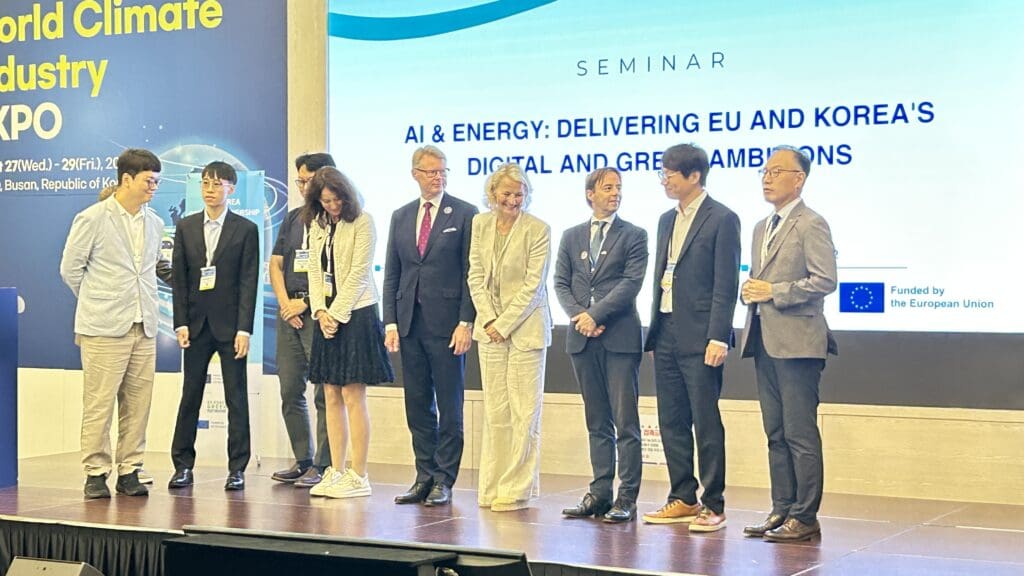
From August 27–29, 2025, I had the privilege of attending the World Climate Industry Expo (WCE) at BEXCO, Busan, as representative of the Dutch Business Council Korea (DBCK). Mr. Peter Wijlhuizen, Head of Innovation, Technology & Science represented the Embassy of the Kingdom of the Netherlands in Seoul attended the seminar, meeting global policymakers, researchers, and industry leaders to discuss one of the most pressing challenges of our time: how to accelerate the transition to renewable energy while balancing economic growth and social acceptance.
The current energy reality in Korea
The sessions made one thing unmistakably clear: Korea’s path to renewable energy is heavily constrained by its existing structures.
- Dependence on fossil fuels: Nearly 60% of Korea’s power generation still comes from coal and gas, with nuclear energy covering another large share. Renewables represent just a small fraction.
- KEPCO’s monopoly: The state-owned utility KEPCO and its five subsidiaries generate over 90% of electricity through fossil fuels, maintaining an oversized influence over the power market.
- Coal-to-gas transition: Government policy continues to prioritize gas-fired power expansion rather than a direct shift to renewables, locking the country into new fossil infrastructure.
As Jang Hyeok Lim, researcher at SFOC (Solutions for Our Climate) put it:
“Korea must power an AI supercycle and decarbonize at once, but the current system is blocking the road to true renewable energy.”
The AI–Energy Nexus: No Green AI without Green Chips
One of the most forward-looking themes was the interdependence of artificial intelligence (AI) and renewable energy.
- AI for Energy: AI technologies can optimize grid management, forecast renewable output, and integrate more clean power into the system.
- Energy for AI: At the same time, Korea’s booming semiconductor industry—with Samsung and SK Hynix at its core—faces skyrocketing energy demand. Without a reliable supply of renewable power, Korea’s ambition to lead in “green AI” will falter.
- The warning: Current renewable targets are insufficient to meet even the projected demand of chipmakers. Today, only about 5% of their electricity comes from renewables.
One slide summed it up powerfully: “No Green AI without Green Chips.”
Offshore Wind: Opportunities and Obstacles
Korea has announced ambitious plans for 34 GW of offshore wind projects, and companies like Ørsted Korea, represented by Country Manager Jungmin Park, shared their expertise. Yet, four urgent challenges were repeatedly highlighted:
- Permitting – Regulatory gaps slow down project approvals.
- Social Acceptance – Resistance from fishermen and local residents remains a barrier.
- Supply Chain – Korea’s offshore wind sector needs expansion and long-term investment.
- Infrastructure – Grid capacity shortages risk delaying projects, making timely upgrades critical.
The lesson from Ørsted’s own journey was inspiring: transforming from a fossil-heavy company into the world leader in offshore wind required bold, long-term decisions—including exiting oil and gas, converting biomass plants, and closing coal entirely by 2024.
A System in Tension
The conference also revealed a deep tension in Korea’s energy strategy:
- On the one hand, global companies like Samsung and SK Hynix commit to RE100, pledging to run entirely on renewables by 2050.
- On the other, new fossil fuel–based clusters are still being announced, undermining those very commitments.
- Public opposition to new gas plants is growing, while uncertainty around hydrogen’s “clean” status adds complexity.
As several speakers emphasized, Korea risks falling into a policy contradiction: aiming for net-zero while simultaneously expanding fossil capacity.
The Role of International Partnerships
For me, attending as DBCK representative the seminar underscored the value of international collaboration. Dutch expertise in offshore wind, circular economy, and digital green solutions aligns closely with Korea’s urgent needs. The Netherlands is not only a partner but a living example of how bold energy transitions can be achieved while maintaining industrial competitiveness.
Looking Ahead
The World Climate Industry Expo 2025 in Busan was more than a showcase—it was a reality check. Korea stands at a crossroads:
- Continue investing in fossil pathways that delay the transition, or
- Seize the renewable opportunity, leveraging international cooperation to build a resilient, green energy system.
As Mr. Lim warned, the current situation is blocking the road to renewables. Yet, the insights shared at the Expo also showed that solutions exist—if policymakers, industry, and society are willing to act decisively.
For me as a representative of the Dutch Business Council Korea, it was an interesting opportunity in attending this seminar . The road is steep, but the opportunities for collaboration are substantial .