

Notes from a city that refuses to be a footnote
When entrepreneurs look at South Korea, Seoul is usually the first city that comes to mind. And I understand that.
Seoul is the capital. It is where many headquarters, embassies, investors, universities and decision-makers are located. If you are new to Korea, Seoul feels like the obvious starting point.
But living and working in Busan has changed the way I look at this.
From a distance, Busan is often seen as Korea’s second city. A coastal city. Beaches, seafood, mountains, a somewhat slower rhythm than Seoul. All true. But incomplete. Busan is not a smaller Seoul. It has its own economic logic. And for Dutch, European and other international entrepreneurs, that matters.
The Seoul reflex
There is a kind of Seoul reflex when people talk about Korea.
- Business trip? > Seoul.
- Market entry? > Seoul.
- University visit? > Seoul.
- Government meeting? > Seoul.
- First exploratory visit? > Again: Seoul.
That is not wrong. Seoul is powerful, dense and important. No serious Korea strategy can simply ignore it. But if Seoul becomes the only lens through which we look at Korea, we may miss something.
Korea is not only Seoul.
That sounds simple, but in practice many foreign organisations still behave as if the rest of the country is secondary. Interesting perhaps, but not central. Good for a weekend visit maybe, but not for serious business thinking.
That is too easy. Especially when we talk about Busan.
A port city with its own logic
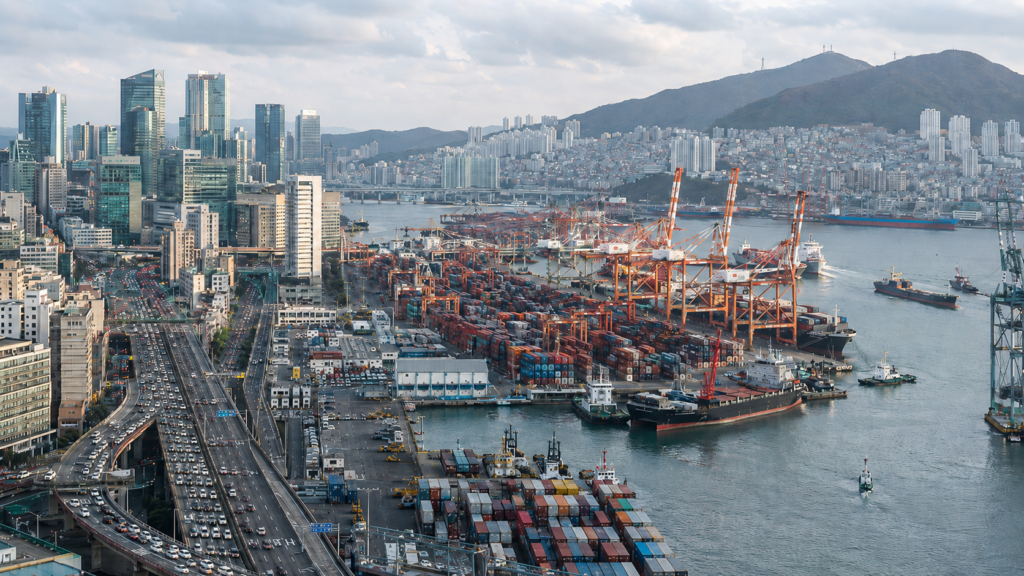
Busan is Korea’s main port city and one of the major maritime and logistics hubs in Northeast Asia.
• Busan’s Economic Focus: Global container hub, leading MICE hub in Asia, and center of Korea’s maritime finance industry.
• Busan Port’s Role: Logistics hub in Northeast Asia.
• Busan Port’s Performance: Handled a record 24.4 million TEU in 2024.
That is not a small local detail.
A city with that kind of port, logistics and maritime profile should not be treated as a provincial afterthought.
For entrepreneurs, this should be interesting and certainly also for Dutch entrepreneurs.
The Netherlands understands ports. It understands logistics, water, maritime services, food systems, trade, practical engineering and applied innovation. These are not abstract themes in the Dutch economy. They are part of how the Netherlands works internationally. So when a Dutch company looks at Korea, the first question should perhaps not always be:
“How do we get into Seoul?” Sometimes the better question is: “Where in Korea does our sector actually fit?”
For some companies, the answer will absolutely be Seoul. But Seoul is not the whole map. And Busan is not the only alternative.
Ulsan matters for automotive, shipbuilding, petrochemicals, batteries and energy. Daejeon matters for science, R&D and deep-tech ecosystems around Daedeok. Daegu has its own industrial profile, with roots in textiles, machinery and automotive parts, and a growing focus on future industries such as water, renewable energy, future vehicles and ICT convergence. Incheon has its own logic around airport connectivity, logistics, bio, education and access to the wider Seoul Metropolitan Area.¹¹–¹⁴
The point is not to replace one default city with another.. The point is to look at Korea with a more accurate map. For some companies, that map will still lead to Seoul. For others, Busan deserves a much more serious look.
Not cheaper, not second-best
I do not think Busan should be sold as “cheaper Seoul”. That would be the wrong story.
If a company only looks at Busan because it hopes things will be cheaper, easier or less competitive, it may be disappointed. Korea is Korea. Relationships matter. Hierarchy matters. Timing matters. Language matters. Local trust matters. Nothing moves automatically because you arrive with a good product, a polite smile and a decent PowerPoint.
Busan is not easy. But it can be more readable. That is different.
The city has a strong regional identity. People know what Busan is good at. The lines can sometimes be shorter. The link between port, city, university, events, food, logistics and local government ambition is easier to observe on the ground. Not always easy to enter. But easier to understand if you are actually here. And that is where I think Busan becomes interesting: not as a second-best option after Seoul, but as a strategic option with its own strengths.
Food, culture and the real city
There is another side to Busan that should not be dismissed as “soft”. Food. Local culture. Markets. Film. Tourism. Neighbourhoods. People arriving, leaving, working, studying, eating, trading, staying for a while or trying to build a life here.
That is not just lifestyle decoration around the “real economy”. It is part of how a city becomes internationally readable.
Busan has been investing in city branding, tourism and local culture. Recent initiatives such as the BE LOCAL campaign with NAVER Maps are aimed at helping international visitors find local restaurants, cafés and shopping areas more easily. Visit Busan also actively promotes the city’s food culture through official tourism channels.⁴–⁵
Of course, we should not exaggerate this.
A food campaign does not suddenly turn a city into an international business hub. A slogan is not a strategy. A nice video does not solve language barriers, housing issues or the practical problems foreigners face.
But food and culture do matter. They make a city approachable. They give visitors and residents something to hold on to. They create places where people meet without immediately sitting in a formal meeting room. For a city that wants to become more international, that layer is not cosmetic. It is part of the infrastructure of trust.
And Busan has something there.
It is rougher than Seoul in some ways. Less polished. Sometimes less predictable. But also more direct, more physical, more coastal, more industrial, more local. That is part of its charm — and part of its challenge.
Education is not a side topic
There is another point I do not want to leave out: education.
For me, education is not a separate sector somewhere at the edge of internationalisation. It is one of the foundations under almost everything else.
Talent. Language. Internships. Research. Exchange. Trust. Long-term relationships. Young people who understand more than one country. Universities that connect local industries with international networks. Students who later become employees, founders, translators, researchers, partners or clients.
That is not soft. That is strategic.
Busan has many universities and a large student population. For a city that wants to be more international, education matters deeply. Not just because international students bring numbers, but because they can become bridges between Busan and the rest of the world.
This is also where my own background probably influences how I look at the city.
I come from education. I spent a large part of my professional life in schools, leadership and educational advisory work in the Netherlands. So when I look at Busan, I do not only see a port city. I also see a learning city: students, universities, language barriers, international ambitions and a need for better practical guidance.
Business and education are often discussed separately. On the ground, they are connected.
Internationalisation is not only about ports, airports or investment plans. It is also about whether people can actually find their way.
Internationalisation has to work on the ground
Internationalisation is a beautiful word. Sometimes too beautiful I think. It easily becomes something for policy documents, conference banners and city slogans. But the real test is much more practical.
Can foreigners find reliable information? Can students understand where to study? Can entrepreneurs find the right first conversation? Can residents arrange daily life without guessing everything? Can local organisations explain themselves clearly to people who are new to Korea?
In short: can a city become readable?
Busan is making visible steps in that direction. The city has worked on foreign resident support through platforms such as MyBusan, which provides practical information for foreign residents and international students, including daily life, education and visa-related information. Busan Global City Foundation also provides support services for foreigners living in the city.⁶–⁷
These things are not glamorous. But they matter.
Because internationalisation is not only about airports, ports, investment plans or big events. It is also about whether people can actually find their way: where to study, who to meet, how to understand a neighbourhood, where to ask questions, how to build trust and how to avoid wasting six months because nobody explained the first step properly.
That practical layer is exactly what many cities underestimate. And it is exactly where Busan still has work to do. But the direction is visible.
The practical layer: OurBusan.life
That is also why I appreciate smaller practical initiatives such as OurBusan.life.
Not because one website solves everything. It does not. But because it tries to do something that sounds simple and is actually difficult: make Busan more understandable for foreigners on the ground. Daily life. Neighbourhoods. Universities. Events. Practical guidance. Local context.⁸ This is the kind of layer international cities need if they want people not only to visit, but also to stay, study, work, connect and contribute.
The big picture matters. But the small details decide whether people actually manage.
From observation to involvement
For me, Busan is no longer just an interesting city to observe.
It is where I live and work.
And that changes the responsibility a little.
As Busan Representative for the Dutch Business Council Korea, I try to help strengthen the Dutch-Korean business community beyond the Seoul Metropolitan Area. The DBCK lists this Busan role as part of its team, and that regional presence matters.⁹
KramerConsult is also a corporate member of the European Chamber of Commerce in Korea. That choice was not accidental. European business in Korea needs more than occasional interest. It needs presence, networks, local understanding and realistic first steps.¹⁰
That is also the reason KramerConsult exists. Not to sell Korea as easy. Not to sell Busan as perfect. Not to pretend that every Dutch or European company should immediately open an office here.
But to help organisations ask better first questions.
What are we actually looking for? Where does our sector fit? Who do we need to speak with? What do we not understand yet? Are we looking at Korea as it really works, or as we imagine it from a distance?
Those are practical questions. And in Korea, practical questions matter.
A city still developing
Busan is vibrant, but not polished. It is developing, but not always easy to read. Ambitious, but still dealing with the normal friction of a city that wants to become more international while remaining deeply Korean.
That makes it interesting.
There is port infrastructure, maritime logic, food culture, education, tourism, universities, MICE activity and local government ambition. There are also gaps: language gaps, information gaps, cultural gaps, coordination gaps and follow-up gaps. The kind of gaps that do not always appear in glossy presentations, but that every foreign entrepreneur or student eventually runs into.
That is the real Busan.
Not the postcard version. Not the slogan version. The working city: port city, student city, food city — still rough in places, but real.
And that is exactly why it deserves a closer look.
Korea is not only Seoul
Seoul is important. Let’s not pretend otherwise. For many companies, Seoul will remain the right starting point. For some sectors, it is simply unavoidable.
But Korea is not only Seoul.
And for Dutch, European and global organisations working in logistics, maritime industries, food, education, tourism, events, regional partnerships, urban development or applied technology, Busan may deserve a more serious look. Not as a cheaper Seoul — not as a second-best option — but as a strategic option with its own logic.
For me, that is the real point. Busan is not asking to replace Seoul; it is asking to be understood on its own terms. And for some entrepreneurs, that may be exactly where the first serious conversation should begin.
At KramerConsult, we help Dutch and international organisations look at Korea from the ground: through practical research, local orientation, partner search and realistic first steps.
No brochure talk.
Just trying to understand where the real fit might be.
Sources
¹ Busan Metropolitan City — Invest Busan: International Business Hub
² Busan Port Authority — Logistics Hub in Northeast Asia
³ Ministry of Oceans and Fisheries / Korea.net — Korea’s ports handle record-high container volume; Busan Port 24.4 million TEU in 2024
⁴ Busan Metropolitan City — BE LOCAL campaign with NAVER Maps
⁵ Visit Busan — Official food and gastronomy information
⁶ MyBusan — Integrated platform for foreign residents and international students
⁷ Busan Global City Foundation — Foreigner support services
⁸ OurBusan.life — Practical Busan community and local guide for foreigners
⁹ Dutch Business Council Korea — Team page
¹⁰ European Chamber of Commerce in Korea / ECCK — Kramer & Co Consulting
¹¹ Invest Korea — Ulsan: automobile, shipbuilding & marine, petrochemical, secondary battery and energy industries
¹² Invest Korea — Daejeon / Daedeok Innopolis: Korea’s largest R&D Special Zone
¹³ Invest Korea — Daegu National Industrial Park: textiles, automotive parts, water, renewable energy, future vehicles and ICT convergence
¹⁴ Invest Korea / IFEZ — Incheon Free Economic Zone: logistics, bio, medical care, education and high-tech industries