

Two Strong Pathways in Dutch Higher Education
When Korean students and parents start exploring study opportunities in the Netherlands, they quickly come across two different types of universities: Research Universities En Universities of Applied Sciences.
At first, this can be confusing. In Korea, the word “university” is often associated with academic, theoretical and research-oriented institutions. Many families therefore naturally look first at academic reputation, international recognition, rankings and future opportunities.
That is understandable. However, to make a good study choice in the Netherlands, it is important to understand how the Dutch higher education system works.
The Netherlands has developed two strong forms of higher education. Both have their own character, their own way of learning and their own value for students.
The right question is not only:
“Which university has the most famous name?”
A better question is:
“Which learning environment fits this student best?”
좋은 대학 선택은 이름보다 ‘학생에게 맞는 환경’에서 시작됩니다.
A good university choice starts not only with a name, but with the right environment for the student.
Two Types of Higher Education in the Netherlands
Dutch higher education has two main pathways: research-oriented education En profession-oriented education.
Research-oriented education is mainly offered by Research Universities. Profession-oriented higher education is offered by Universities of Applied Sciences, known in Dutch as hogescholen.
This distinction is important. It is not simply a difference in name. It is a difference in learning style, educational focus and student development.
Research Universities are strongly connected to academic research, theory and the development of new knowledge. Universities of Applied Sciences focus on the practical application of knowledge, research and methods in professional and real-life situations.
Both routes can be valuable. The key is to understand which route fits the student’s personality, learning style, ambitions and future plans.
Research Universities: Academic and Research-Oriented
Research Universities are academically oriented. Students learn how to ask scientific questions, analyse theories, conduct independent research and contribute to the development of new knowledge.
This type of education can be a strong fit for students who enjoy abstract thinking, theoretical models, academic reading and writing, and independent study. It may also suit students who are considering a future in research, academia, policy, consultancy or a more academic master’s programme.
A student at a Research University is often expected to work independently. The focus is on academic analysis, research methods, theoretical depth and scientific writing.
For students who are motivated by theory, research questions and the development of new knowledge, this can be an excellent pathway.
깊이 있는 이론과 연구를 좋아하는 학생에게 적합한 길입니다.
This pathway fits students who enjoy theory, research and academic depth.
Universities of Applied Sciences: Applied Knowledge in Practice
The term University of Applied Sciences is important. “Applied” means that knowledge and research are connected to practice.
At a Research University, the focus is often on academic research, theory-building and developing new scientific knowledge. At a University of Applied Sciences, the focus is on applying knowledge, research and methods to current situations in professional practice.
This does not mean that research is less important. On the contrary, good practice-oriented education is built on reliable knowledge and research. Students learn how to use scientific insights, data, theories and methods to solve concrete problems in companies, organisations, education, healthcare, technology, hospitality, communication and other professional fields.
At the same time, students learn to work critically with knowledge. They develop the ability to evaluate theories, sources, data and research results before applying them. They do not simply “do practical work”. They learn to act professionally on the basis of well-founded knowledge.
Important questions include:
- Where does this knowledge come from?
- Is the research reliable?
- Does this theory fit the situation?
- Are the conclusions logical?
- Are there other possible explanations?
- Can we responsibly use this knowledge in this specific context?
This is the core of applied sciences:
understanding knowledge, evaluating it critically and applying it in real situations.
Knowledge becomes especially valuable when it can also be used. Research is necessary for new insights, but application is needed to give those insights meaning in society, in organisations and in professional life.
That is why students at a University of Applied Sciences often work on practice-based cases, group assignments, presentations, internships and projects with the professional field. They develop subject knowledge as well as professional skills: analysis, communication, teamwork, planning, presenting, critical thinking and developing well-supported solutions.
For students who like active learning and want to prepare for an international career, this can be a very strong learning environment.
배운 지식을 실제 상황에 적용하는 힘을 기릅니다.
Students develop the ability to apply knowledge in real situations.
From Knowing to Using Knowledge
One important difference is how students work with knowledge.
In many educational environments, strong emphasis is placed on understanding, remembering and reproducing knowledge. That is valuable, because without a solid knowledge base, students cannot act professionally.
However, in an international study and work environment, students also need to learn how to use knowledge in new situations.
A University of Applied Sciences helps students make that step. Students learn not only what a theory means, but also how that theory can be applied. They learn to connect knowledge with real questions from companies, organisations and society.
This requires skills beyond studying for an exam. Students learn to communicate, collaborate, justify their choices, process feedback, present results and take responsibility for their own learning process.
For many students, this is exactly the phase in which they grow strongly: from a good student into a young professional.
지식을 아는 것에서, 지식을 사용하는 단계로.
From knowing knowledge to using knowledge.
The UAS Learning Environment Can Be Interesting for Korean Students
For many Korean students, a University of Applied Sciences can be attractive because the learning environment is practical, personal and international.
Korean students often bring a strong academic foundation. They are used to studying seriously, taking responsibility for their future and showing great commitment. These qualities can be very valuable when they study in the Netherlands.
At the same time, in conversations with students and parents, we notice that other questions are also becoming important alongside academic reputation.
- How does the student learn best?
- Is there enough guidance?
- Can the student actively use English?
- Is there room for international experience?
- Does the programme prepare the student well for a future career?
A University of Applied Sciences can fit students who do not only want to build knowledge, but also want to learn how to use that knowledge. Students often work in smaller groups, receive direct guidance, do projects, give presentations and collaborate with international classmates.
As a result, they develop not only academic and subject knowledge, but also confidence, communication skills, teamwork and professional thinking.
For Korean students who want to grow internationally, this can be a powerful learning environment. They learn to express their ideas clearly, support their opinions with arguments, use feedback, work with people from different cultures and gradually become more independent.
Reputation and academic quality remain important, of course. But in an international study choice, the personal match is also important: does the learning environment fit the student’s character, learning style and future plans?
A well-known name can open doors. A well-matched learning environment can help a student truly grow.
That is why a University of Applied Sciences can be a very conscious choice for some Korean students: a choice for active learning, international experience, personal development and a strong connection between study and future career.
학생의 성장을 돕는 환경이 진짜 경쟁력이 될 수 있습니다.
A learning environment that helps a student grow can become a real strength.
The Transition to Active Learning
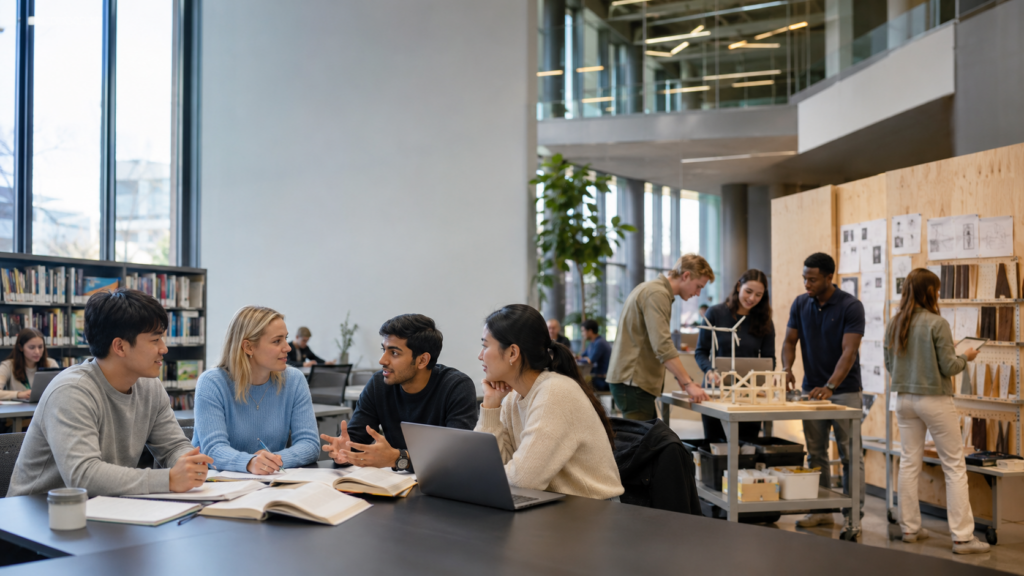
Studying at a University of Applied Sciences requires active participation. Students do not only listen to lectures. They also work on assignments, cases, presentations and group projects. They explain their ideas, support their choices and learn to collaborate with students from different countries.
For some international students, this may take some adjustment at first. But this way of learning can also help students build confidence. They develop their English not only in class, but also through discussion, teamwork, presentations and daily communication.
This is important. In an international career, subject knowledge alone is not enough. Employers also look at communication skills, problem-solving ability, teamwork, intercultural skills and independence. These skills are practised continuously in practice-oriented education.
수업을 듣는 학생에서, 적극적으로 참여하는 학생으로.
From listening to participating.
The Role of Guidance
Guidance is important for international students. Studying abroad means much more than starting a new academic programme. It also means adapting to a new language, culture, communication style and way of living independently.
A more personal learning environment can help with this transition. Students often know more quickly where to go with their questions. Teachers and supervisors are closer to the learning process. Through projects and group work, students also get to know other students more naturally.
For parents, this is an important point. International study is not only an academic choice. It is also a personal step. The student needs to feel safe enough to ask questions, participate, grow and take responsibility.
해외 유학은 학업뿐 아니라 성장의 과정입니다.
Studying abroad is not only about academics; it is also a process of growth.
Internships, Projects and Connections with the Professional Field
One of the strengths of Universities of Applied Sciences is their connection with the professional field. Students often work on assignments linked to real companies, organisations or social questions.
Internships, professional projects and practice-based assignments often play an important role in this type of education. As a result, students build not only knowledge, but also experience, networks and insight into their future field.
This is especially important for students who want to work internationally after graduation. They do not only learn the theory of their field. They also learn how professionals think, communicate and collaborate in practice.
전공 지식과 현장 경험을 함께 쌓아갑니다.
Students build both subject knowledge and practical experience.
Which Student Fits Which Route?
The Netherlands has developed these two routes for a reason. Students are different. Their talents, learning styles, personalities and future plans are different.
Some students want to focus mainly on academic research. Others learn best by doing, experiencing and applying knowledge.
Some students are motivated by theory and scientific depth. Others grow through projects, practice-based learning, personal guidance and collaboration with teachers and fellow students.
A Research University often fits students who:
- enjoy independent and theoretical study;
- like reading, analysing and writing;
- are interested in academic research;
- may consider a PhD or research career later;
- function well in an abstract and academic environment;
- need less day-to-day guidance in their study process.
A University of Applied Sciences often fits students who:
- like learning by doing;
- want to apply knowledge in realistic situations;
- appreciate guidance and structure;
- want to collaborate with others;
- want to actively use their English;
- want to prepare for a professional career;
- want to grow in independence, communication and confidence.
That is why it is important to look carefully at the student. Not every student grows best in the same environment.
A good study choice begins with the question:
Who is this student, how does he or she learn best, and what kind of future does he or she want to build?
모든 학생에게 같은 길이 맞는 것은 아닙니다.
Not every student needs the same pathway.
A Short Comparison
| Question | Research University | University of Applied Sciences |
|---|---|---|
| Main focus | Academic theory, research, knowledge development | Application, practice-oriented research, professional development |
| Learning style | Independent, analytical, theoretical | Projects, cases, internships, collaboration |
| Best fit for | Students who seek research and theory | Students who want to apply knowledge in practice |
| Skills developed | Academic writing, analysis, research methods | Communication, teamwork, presentation, problem-solving |
| Future direction | Academic master, research, policy, PhD | International career, professional field, practice-oriented master |
What Does This Mean for Parents?
For parents, it is natural to look at reputation, safety, costs and future opportunities. Especially when a son or daughter goes abroad, the decision must be made carefully.
But in an international study choice, there is another question that is just as important:
In which environment can my son or daughter truly grow?
Some students need an academic and theoretical environment. Other students develop more strongly in a practice-oriented environment with more guidance, collaboration and personal interaction.
The best choice is therefore not always only the most famous name. The best choice is the programme and learning environment that fits the student and his or her future.
부모님의 가장 중요한 질문: 우리 아이가 어디에서 가장 잘 성장할 수 있을까?
The key question for parents: where can my child grow best?
Korean Students in the Netherlands
International students in the Netherlands study at both Research Universities and Universities of Applied Sciences. Korean students are part of this international learning environment.
They choose the Netherlands not only because of its international reputation, but also because of English-taught programmes, an open learning environment and the strong connection between study and practice.
Exact numbers can differ per year and per institution, so this article does not make broad statistical claims. But it is clear that Korean students are already present in Dutch higher education, including practice-oriented international programmes.
For Korean students who are ready for an active, international and professionally connected way of learning, the Netherlands can offer a valuable pathway.
네덜란드는 다양한 국제 학생들이 함께 배우는 열린 교육 환경을 제공합니다.
The Netherlands offers an open learning environment where international students learn together.
Studying at NHL Stenden and Hanze
As representatives in Korea, we work with NHL Stenden University of Applied Sciences En Hanze University of Applied Sciences. Both institutions offer internationally oriented programmes in which practice, guidance and professional development are central.
At NHL Stenden, students learn through Design-Based Education. This means that students work on realistic questions and learn by researching, designing, testing, improving and applying ideas. Students do not only attend lectures. They actively learn by collaborating, developing solutions and applying knowledge in concrete situations.
For many international students, this creates a dynamic and supportive learning environment.
Hanze University of Applied Sciences is located in Groningen, one of the best-known student cities in the north of the Netherlands. Hanze focuses on education and practice-oriented research connected to current social and professional questions. Students, researchers and professional partners work together on solutions and innovations for professional practice and society.
For Korean students who want to grow internationally, become more independent and connect their studies directly with their future, NHL Stenden and Hanze can be very interesting choices.
NHL Stenden과 Hanze는 실무 중심의 국제 교육 환경을 제공합니다.
NHL Stenden and Hanze offer internationally oriented, practice-based learning environments.
Studying in the Netherlands Starts with the Right Match
Studying in the Netherlands can be a wonderful step for Korean students. But a good choice starts with understanding the system.
Research Universities and Universities of Applied Sciences both offer strong opportunities. The best choice depends on the student: character, learning style, ambitions, independence and future plans.
We help Korean students and parents understand these choices clearly. Not by simply promoting one institution, but by looking together at which route is realistic, suitable and future-oriented.
In a personal consultation, we look not only at grades and diplomas, but also at character, learning style, English level, independence, future plans and the question of which learning environment fits best.
Are you interested in studying at NHL Stenden, Hanze University of Applied Sciences or another Dutch institution? Please feel free to contact us for a first orientation meeting.
A good study choice does not start with a name alone.
It starts with the right match between student, programme and future.
학생, 전공, 미래가 잘 맞을 때 좋은 유학이 시작됩니다.
A successful study abroad journey starts when student, programme and future fit together.