

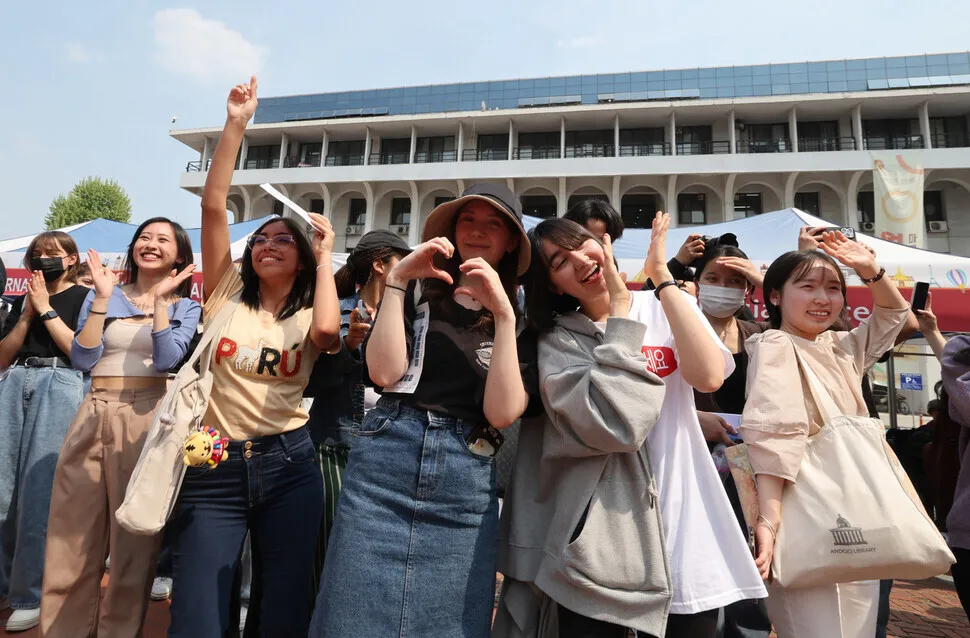
A new reality — and a growing opportunity for foreign students.
Korea’s higher-education landscape is changing rapidly. For years, universities have welcomed international students, but the tone of the discussion is shifting. The leadership of several major universities has now openly stated that global talent is not just a nice addition — it is becoming essential for the future of Korean higher education and research.
In recent months, multiple university presidents have spoken with unusual clarity about this. Their message is consistent:
Korean universities can no longer rely on domestic students alone, and the academic environment must adapt so international students can genuinely succeed.
Below is an overview of what key university leaders are saying, followed by what this means for future international students — in straightforward terms.
Chungbuk National University (CBNU): “We cannot survive without foreign brainpower.”
In an interview with The Korea Times, CBNU president Koh Chang-seop stated:
“We are reaching a point where it will be impossible to survive without foreign brainpower, and that means creating an academic culture that truly supports international students, not just welcoming them in name only.”
CBNU is currently expanding English-medium courses, strengthening research environments, and connecting students to lab-based projects tied to industry. The university emphasizes that support should not end at the admissions office — students must find proper guidance, academic structure, and real opportunities during their studies.
University of Seoul (UOS): “We must embrace inclusiveness.”
In another recent interview, the president of the University of Seoul, Won Yong-kul, underlined a similar point:
“We must understand diverse cultures, embrace inclusiveness and contribute to the international community as a developed country.”
UOS has historically been modest in international recruitment, but the university now clearly recognizes the need to globalize its campus. Their focus is on cultivating an environment where Korean and international students can work together and prepare for careers that increasingly cross borders.
Seoul National University (SNU): Globalization as the foundation, not an extra
At Seoul National University, president Ryu Hong-lim described globalization as core to the university’s future mission:
Global engagement should not be treated as an additional option or a side project. It must be embedded into the university’s identity.
SNU emphasizes cooperation with institutions worldwide and aims to educate “global citizens.” The university describes international students as active contributors to this mission, not simply guests on campus.
Regional universities: demographic reality is pushing change
Several regional universities have made similar statements in the Korean press.
The message is straightforward:
- Korea’s population is shrinking
- Many local institutions face declining domestic enrollment
- International students are becoming essential to long-term survival and innovation
Some universities are expanding scholarships, adding English-medium graduate programs, and creating pathways that link international students to local industries — particularly in engineering, biotechnology, IT and applied sciences.
(If you want, I can also add clickable links for these institutions once you choose which ones you want to mention.)
What this means for international students
The statements from university presidents are unusually direct for Korea. They also reflect a genuine shift happening across the sector. For students considering Korea, the implications are practical and positive.
1. More English-friendly academic programs
Universities are increasing the number of courses taught in English, especially in engineering, business, computer science and research-oriented fields.
2. Stronger student support systems
International offices, buddy programs, onboarding sessions and mentoring systems are being expanded and professionalized.
3. Clearer academic structure for foreign students
Universities acknowledge that “admitting” international students is not enough. The focus is shifting to:
- course accessibility
- academic feedback
- participation in labs
- fair grading
- guidance on academic expectations in Korea
4. Better career-linked opportunities
As universities strengthen connections with industries, international students may find more structured pathways into internships, research labs, and post-graduation opportunities.
5. A more diverse student community
Many campuses already host students from dozens of countries. With these new policy directions, that number is expected to grow significantly over the coming years.
Why this matters for students choosing Korea now
For many years, students often struggled with limited information, language barriers and academic expectations that were not always transparent.
The recent statements from university leaders show that Korean universities understand these challenges — and are taking responsibility for addressing them.
For students who want an Asian study destination with strong academic programs, safe cities and reasonable tuition, Korea is becoming a more structured and supportive environment.
And for universities, international students are no longer seen as “optional” — they are part of Korea’s long-term academic and research future.
How this connects to our guidance
At KramerConsult – Studeren in Korea, we follow these developments closely.
These statements confirm what we experience in practice:
- universities are investing more in onboarding and support
- English-taught tracks are expanding
- communication with international offices is improving
- institutions want foreign students to stay, succeed and contribute
For students preparing to apply, this is a very favorable moment.
If you want help comparing programs, navigating applications or understanding which universities are strongest in your field, we can support you from first orientation to arrival in Korea.
Bronnen
-
Chungbuk National University interview — The Korea Times
“Chungbuk Nat’l Univ. aims for global reach via English-taught programs, industry-tied research”
https://www.koreatimes.co.kr/southkorea/society/20251127/chungbuk-natl-univ-aims-for-global-reach-via-english-taught-programs-industry-tied-research -
University of Seoul interview — The Korea Times
“University of Seoul expands global reach through urban-planning programs”
https://www.koreatimes.co.kr/southkorea/society/20251203/university-of-seoul-expands-global-reach-through-urban-planning-programs -
Seoul National University statement — SNU English News
“Global cooperation as a core mission” (President Ryu Hong-lim)
https://en.snu.ac.kr/snunow/snu_media/news?bbsidx=157068&md=v -
Regional university trends — Korean higher-education press
Hangyo Education News
https://www.hangyo.com/news/article.html?no=103487
Nate News
https://news.nate.com/view/20251115n12847