
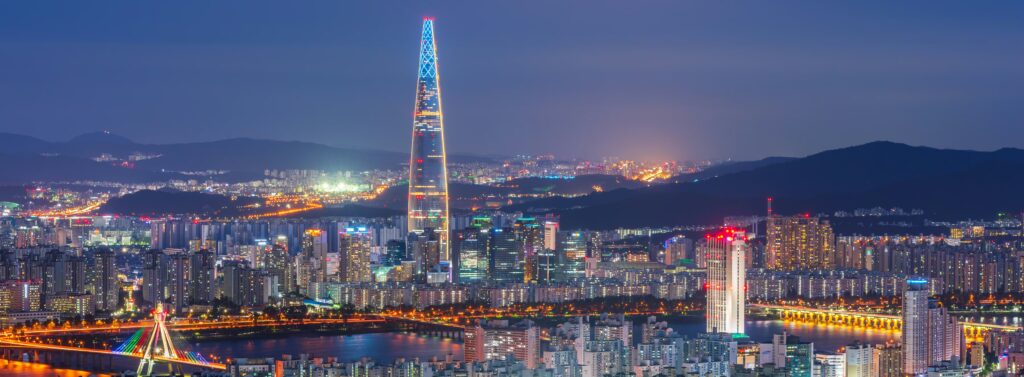
Now that I have been living here for over a year, old friends, acquaintances and former colleagues often see that as something special. At the same time, they are curious. I regularly get questions about South Korea, and especially about how the country positions itself on the world stage — particularly now that global politics are unsettled and power relations and values are clearly shifting.
There is no simple answer to that. Still, I try to give one here. Not because I claim to know the truth, but because I live and work here and follow this topic with interest. Feel free to respond — I actually welcome that. I certainly don’t have all the answers. But I do think these observations give a fairly realistic picture of how Korea operates and why.
I don’t follow South Korea’s international position from an academic point of view, but because it matters for how the country functions and makes decisions. For my advisory work, it also helps to understand the environment in which Korea operates. That naturally makes me pick up, reread and reflect on these kinds of topics.
Balancing is not a strategy, but a daily reality
South Korea has little room for bold geopolitical statements. The country’s security is closely tied to the United States. That relationship is crucial, especially given the situation with North Korea. At the same time, China is economically very important. It is a key trading partner, a major market, and part of many supply chains in which Korean companies are active.
This tension is not a deliberate strategy; it is simply a fact of life. Korea cannot afford a hard break with either side. As a result, the country often chooses a cautious and carefully balanced approach. Big statements are avoided, nuance matters. From the outside, this can sometimes look indecisive. From close up, it feels mainly practical and realistic.
Caution beyond the Korean peninsula
What stands out is that South Korea tends to be careful when it comes to international conflicts that do not directly affect the Korean peninsula. This can be seen in its stance on Ukraine, but also in tensions around Taiwan. That does not mean Korea has no position or does not share certain values, but it does mean the country is very aware of the consequences of strong, outspoken statements.
Many analyses I read point to the same thing: for Korea, stability in its own region comes first. Anything that could disrupt that stability — economically or in terms of security — is weighed very carefully. From that perspective, restraint is not weakness, but a conscious choice.
The relationship with China: essential and uncomfortable
Korea’s relationship with China is both necessary and uncomfortable. China is a huge market and an important partner in industry and technology. At the same time, there is a clear awareness in Korea that economic dependence also creates vulnerability. In the past, political tensions have directly led to economic consequences.
That is why Korea seems to be following two paths at once. On the one hand, cooperation with China remains important. On the other hand, Korea is gradually trying to reduce its dependence by investing in other markets, new technologies and strategic sectors. This usually happens quietly, without much publicity or strong language.
What does this mean for foreign partners?
For foreign partners — including Dutch ones — this approach mainly shows that South Korea strongly values stability, continuity and predictability. The country has little appetite for outside pressure and little room for sudden political changes.
In my own work, I notice that cooperation tends to go more smoothly when there is an understanding of this cautious approach and the broader context in which Korea operates. Expectations become more realistic once you realise that Korea rarely rushes into decisions. This applies to trade, education, technology and advisory work alike.
This piece is not an attempt to draw firm conclusions or make predictions. It is simply how things look right now, seen from close by and informed by people who have been thinking and writing about these issues for much longer than I have.
Reactions? Yes, please.
It would be nice to receive some responses. You may see things very differently — because you know more, or because you look at it from another perspective. If so, feel free to respond to this blog. I’m happy to read along.
Background & reading list
For those who would like to explore further
- Reuters – Asia Pacific
Current reporting and analysis on South Korea, China, the United States, and North Korea
https://www.reuters.com/world/asia-pacific/ - Brookings Institution – Asia & Indo-Pacific
Policy analysis on East Asia, Taiwan, and regional security
https://www.brookings.edu/region/asia/ - CSIS (Center for Strategic and International Studies)
Analysis on South Korea as a middle power and security-related issues
https://www.csis.org/regions/asia - Lowy Institute – Asia Power Index
Comparative analysis of power dynamics in Asia
https://power.lowyinstitute.org/ - 38 North
Specialized platform on North Korea and security on the Korean Peninsula
https://www.38north.org/ - Journal of East Asian Studies
More academic articles on East Asian politics
https://www.cambridge.org/core/journals/journal-of-east-asian-studies